

Enroll online today
Find a class, find a passion
The enrollment process varies by program type. For most group classes and private lessons you can sign up online.
Use the filters below to find your fit across all our locations and online.
Showing 32 of 32
-
 Private Lessons
-
 Private Lessons
-
 Private Lessons
-
 Private Lessons
-
 Little Bears
-
 Group Classes
-

-
 Group Classes
-
 Private Lessons
-
 Group Classes
-
 Private Lessons
-
 Little Bears
-
 Private Lessons
-
Group Classes
-
 Summer Camps
-
 Group Classes
-
Group Classes
-
-
 Group Classes
-
 Group Classes
-
 Group Classes
-

-

-
 Group Classes
-
 Bands
-
 Bands
-
 Bands
-
 After-School
-
 Group Classes
-
Private Lessons
-
 Private Lessons
-
 Group Classes
No classes match yet
Try widening your filters, or reach out and we’ll help you find the right fit.
I walked in at fifty-three having never touched a guitar. Eight months later I played a real show.
New to music?
Everything a first-timer asks
Is piano the best instrument to learn first?
Piano is a foundational instrument. For most musicians, having some piano skills is very useful. Also, music theory is most easily visualized on a piano. But we believe there is no reason to begin your music lessons on the piano if that is not the instrument you are most attracted to. What makes for successful music study is long-term practice. What makes for successful long-term practice is an abiding interest in and attraction to the instrument. On this issue we are on the side of immediate gratification: start with the instrument you most want to play!
How can I choose what instrument to learn?
Maybe you’re not clearly drawn to any particular instrument. Here are some comments that might be helpful as you think about what instrument to start with.
Voice – The voice is really the starting point of music. Most instruments that are capable of playing melody refer back to the human voice – they are all trying to “sing.” When voice is your instrument, no additional equipment is required. Voices are remarkably able to improve. Just by singing more regularly you can strengthen your voice and gain more control over it. And with sustained practice, even the most out-of-tune singers can see real progress. Working on your voice often leads to increased self-confidence in other areas. And it’s a great social asset to be able to break out in song whenever the need arises.
Guitar – It seems that guitar is the quintessential instrument for accompanying the voice in American popular music. From Woody Guthrie to Tracy Chapman and Beck, from Chuck Berry to the Ramones to Metallica, the guitar is everywhere. Just by learning a few chords, you can bang out literally thousands of songs or write your own.
Ukulele – The “uke” has grown in popularity with artists like Jake Shimabukuro elevating it to a very high level of musicianship. It’s a fun, easy and inexpensive way to start playing music and accompanying yourself singing.
Piano – The piano has a huge repertoire ranging from classical to blues, jazz to pop. It is a fantastic instrument for vocal accompaniment and for solo playing, as well as for ensemble playing. It is the opposite of the acoustic guitar: totally un-portable. It is fine to learn on an electronic keyboard. If you go this route, you should get a keyboard that has at least 5 octaves, has full-sized keys, and is touch-sensitive (the harder you strike a key, the louder the sound it produces). Even better is to get a keyboard with weighted action (similar to that of a real piano), though these are more expensive. Electronic keyboards are great for playing in bands and for situations where sound level is a consideration. You should realize, however, that electronic keyboards do not come close to the living, breathing, hugely dynamic and very individual natures of real pianos. Just as there is a huge palette of sound available to you with synthesizers, there is a huge palette of nuance, dynamic range and expression with an acoustic piano that cannot be replicated with an electronic keyboard. A lot of catchy synthesizer sounds get old after a while. The sound of an acoustic piano is still of interest to our modern ears centuries after the instrument was first developed.
Bass – The bass may be one of the easier instruments to learn – we’ve had students join our band workshops after only 6-9 months of instruction. It is clearly an instrument meant for playing with others. Given the popularity of singing and guitar playing, it seems that people are always looking for a bass player to complete their band! Unlike the guitar and piano on which you are playing chords (groups of several notes played together), the bass plays primarily single notes and usually locks in rhythmically with what the drummer is playing. It’s a whole lot of fun to play, and gratifying to be wanted by others for your musical skills.
Drums – Drums are probably the most physical of all the instruments. You’re playing with all four limbs as you lay down the groove for everyone else. As the drummer, you are the keeper of time, in charge of the feel. Like the bass player, you are in demand. It is possible to start drum lessons without getting a full kit. You can do a lot of work developing good stick control with just drumsticks and a practice pad. But the real fun comes when you get on the full kit, and for this you’ll need a place you can set up and make some real noise.
Saxophone – Sometimes there is just nothing like a wailing sax solo. The emotional tone that comes from someone like Clarence Clemons, Junior Walker or David Sanborn is nothing short of musically hot. And in the world of jazz, the saxophone is perhaps the pre-eminent soloing instrument, like the electric guitar in the world of rock & roll. Need we mention names other than Charlie Parker and John Coltrane? Most students begin on either alto or tenor saxophone; the tenor is bigger and plays a lower range than the alto. Other saxophones include the baritone sax (even bigger and lower than the tenor) and the soprano sax (usually a straight horn, without the curve, that plays higher than the alto). The fingering patterns you learn on any of the saxophones transfer directly to the others. A big deal for all saxophone students is developing a good tone on the instrument. Unlike the piano, where the basic tone of the instrument is set, the saxophone requires the student to do a lot of work before a satisfactory tone is achieved, even on a single note.
Flute – While flute has a minor role in Rock, Blues, Jazz and other Pop styles, it is a wonderful instrument, very satisfying and rewarding to play. It obviously has a major role in classical music, as well as in many folk traditions from around the world. And unlike most other instruments, it is easy to take just about anywhere you might want to go.
Should I learn guitar on an acoustic or an electric?
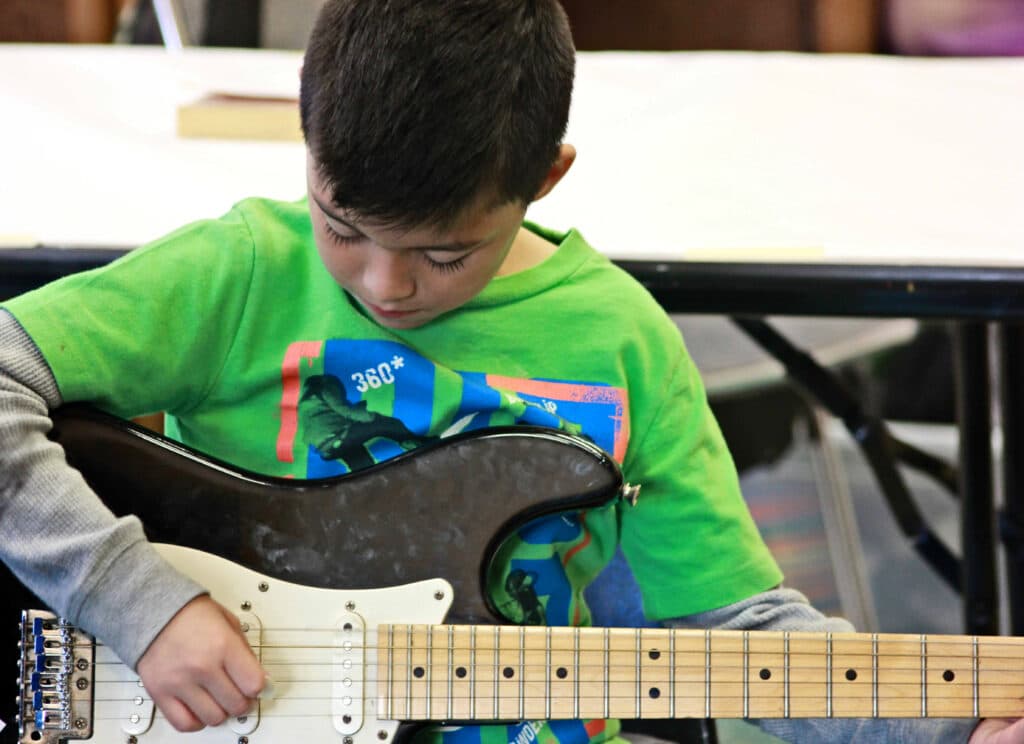
You may have heard that it’s best to start with acoustic guitar before switching over to electric. We do not subscribe to this advice, since we believe it is trumped by the “immediate gratification” principle. If you really want to play electric guitar, then go for it! Square-one electric players may join our Beginning Guitar group class even though mostly acoustic players will be in it. Following are some things you should know.
For beginners, playing an electric guitar is easier than playing an acoustic guitar. Electric guitar strings are smaller in gauge and strung with less tension than acoustic guitar strings, so it takes less pressure to play the notes. If you do learn on an acoustic, you’ll find many things suddenly easier when you play them on an electric. The acoustic guitar forces you to develop strength in your hands and calluses on your fingers more quickly than an electric does. All the chords, scales and strums, and much of the technique are completely transferable between electric and acoustic guitar. However, the kinds of tone you get out of an electric are very different from the tones you get out of an acoustic. There are a lot of techniques very specific to the electric guitar/amp combination that cannot be learned and explored on an acoustic guitar. When all is said and done, we think you should learn to play what turns you on. Of course, the great advantage of an acoustic guitar is that it can be played anywhere, regardless of the availability of an electrical outlet. It’s a great party or campfire instrument, and a great solo or accompaniment instrument. With an electric guitar, you’ll want to get an amp, and you’ll most likely want to be playing with others.
What if I want to write songs?
The first thing you should do is to learn either piano or guitar. You need to be able to come up with chord progressions that will accompany your melodies and lyrics.
Should I learn music theory first?
No, it’s better to learn an instrument before learning music theory. While you might think that learning some theory will facilitate learning an instrument, it’s actually the other way around. Knowing at least some basics on an instrument will make music theory much more understandable and meaningful.
What if I want to make music on a computer?
The better your understanding of the basic elements of music – melody, chords, and rhythms – the better will be your ability to use computers to create music. Gaining some piano skills is highly recommended!
Still deciding?
We’ll help you find the right class, teacher and campus.
-
Meet the teachers
60+ working musicians who teach across a huge range of instruments and levels.
Browse teachers -
Talk to us
Our Program Director will help guide you. Schedule a quick call.
Call the Director